
IMS basket 51mm: what changes in a De'Longhi Dedica test?
A budget basket, an IMS Competition and an All in One tested with the same coffee. What changed in the cup, and why TDS alone cannot pick a winner.

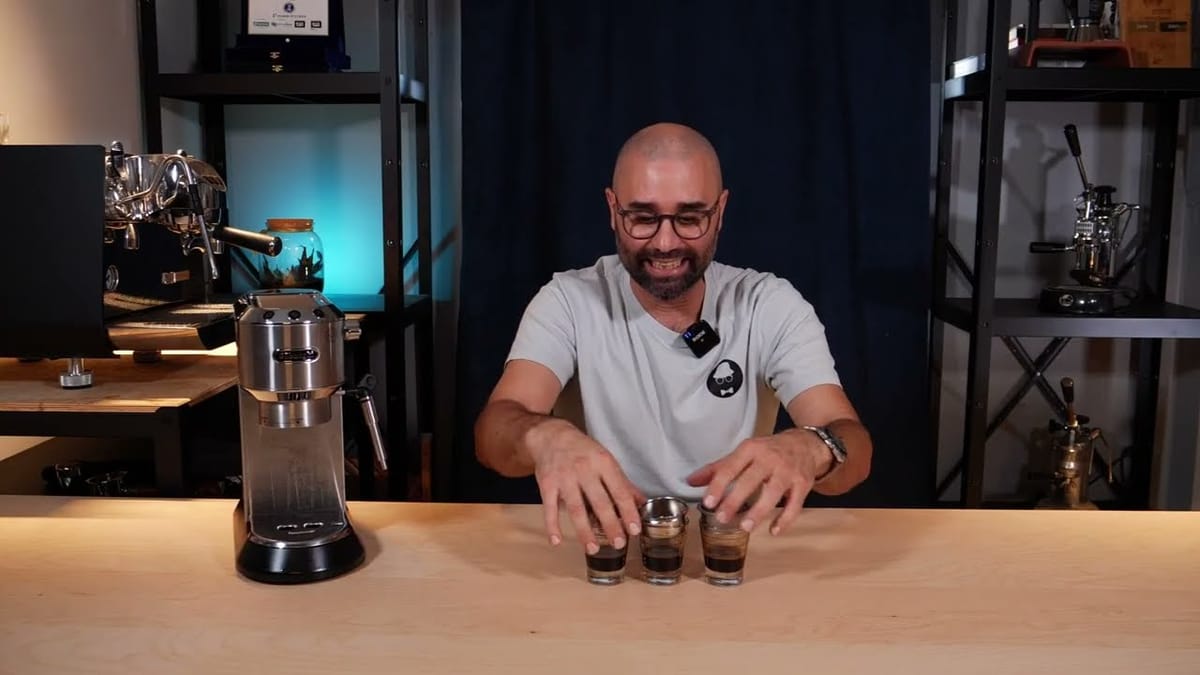
An IMS basket 51mm upgrade can change espresso on a Dedica, but you need to adjust the grind rather than simply swap baskets. In this week's video Angelo compares a budget basket, an IMS Competition and an All in One. The video is in Italian: on YouTube, enable CC and select English under Settings, Subtitles, Auto-translate.
Which IMS basket does Angelo use on the Dedica?
Angelo uses an IMS Competition originally intended for La Pavoni, fitted to his bottomless Dedica portafilter. That is the combination shown in the test, not a guarantee that every basket in the range will fit your portafilter.
The budget basket came with a portafilter kit. The third basket is presented as an All in One for the Dedica, with a membrane above its perforated base. Angelo compares these different constructions using the same commercially available, medium-dark roasted coffee.
Check the exact basket model and your portafilter before buying. A brand name alone does not identify the part. If you are starting with the machine's original accessories, read our explanation of pressurized and traditional Dedica baskets first. This particular test does not compare those two systems.
Why adjust the grind when changing baskets?
Angelo adjusts the grinder to bring the shots towards a similar dose, beverage weight and brewing time, rather than retaining a setting that produces different flows.
He declares the same coffee, water and machine, uses a DF54 grinder, and preheats each basket. His target window is 24-30 seconds, with roughly 32 grams in the cup. He progressively grinds finer, moving from setting 17 to setting 15 during the comparison.
Those settings belong to his grinder and this test: they are not a recipe for yours. The practical question here is what each basket delivers when dialled in towards a similar recipe. It is not a test holding grind size constant as well.
To repeat the comparison, choose your dose and beverage weight first. Record the shots, then dial in each basket. Avoid also changing the coffee or water: that makes it harder to identify what you are comparing. Treat time as part of your notes, not the only measure of a successful shot.
What differences does Angelo taste?
Angelo finds the IMS Competition shot fuller-bodied than the budget basket shot, with bitterness recalling cocoa rather than ash.
- Budget basket: good body and sweetness, but more obvious bitter elements and an ashy aftertaste.
- IMS Competition: more pronounced body, sweetness recalling sugar cane and chocolate, and cleaner-tasting bitterness.
- All in One: a more open cup, good sweetness, toasted bread and cocoa notes. Angelo is less certain about a possible slight reduction in body.
These are his impressions from this tasting, not flavours a basket guarantees. The comparison is not presented as a blinded tasting with statistical results. What it shows is that, in his setup, changing the basket and adjusting the grinder produced differences he could recognise in the cup.
He does not dismiss the budget basket: he says it can work well for someone starting out. An upgrade makes sense if it helps you reach something you actually want to taste, rather than merely a more attractive crema.
What do the refractometer readings show?
The readings describe measured concentration; they do not score espresso quality on their own.
- Budget basket: 12.14% TDS.
- IMS Competition: 11.96% TDS.
- All in One: 11.61% TDS.
TDS describes dissolved solids in the drink. Extraction yield describes the fraction extracted from the coffee dose. ATAGO's explanation of concentration and extraction yield treats them as separate quantities. A reading above 12% does not, on its own, establish over-extraction or explain an ashy aftertaste.
Angelo suggests that the All in One membrane may have retained particles affecting the reading. That is a hypothesis, separate from the observed numbers. VST's measurement documentation explains that suspended solids can interfere with readings and that sample preparation matters. An espresso basket membrane does not automatically replace the refractometer's sample preparation procedure.
Follow your instrument's instructions and prepare every sample consistently. For more context on measurement and tasting, see our introduction to coffee TDS and Caffinity Lab. The numbers can help organise a comparison, but they need a clear question and a consistent method.
Is a Dedica basket upgrade worth it?
It is worth exploring when your preparation is repeatable and you want to compare a specific change in body, sweetness or aftertaste.
If every shot tastes different, first work through the basics in our Dedica EC685 troubleshooting guide. Then try the new basket with the same coffee, note your adjustments, and taste. Do not buy a higher TDS number: look for a cup you enjoy more. Keep the budget basket as your reference rather than assuming it has become useless.
On Patreon this week
For Premium members, Angelo wrote a follow-up on this topic, in Italian and English: IMS Dedica baskets: behind the comparison and your questions. The opening is free to read.
Join the Caffinity community
Caffinity Premium on Patreon offers extra content, enhanced discounts with partner specialty roasters and private Discord channels. You can also join our free Discord community to discuss your own tests.
For more practical coffee and equipment comparisons, subscribe to Angelo's YouTube channel. His videos are in Italian; YouTube's subtitle options can help you follow along.
Read next
Coffee grinder for espresso, moka and filter: what to look for
Manual or electric, ceramic or steel, stepped or stepless: Angelo’s video compares grinders and shows what to consider for your brewing method and daily routine.
Coffee deals on Telegram: we're sharing them on Amanti del Caffè
After our community poll, we’ll share Amazon offers on coffee machines, grinders and accessories on Amanti del Caffè on Telegram, ahead of Black Friday.
Lelit Anita review: how it compares with the Gaggia Classic Pro and Pavoni
An integrated grinder, a separate setup or a manual lever: Angelo compares the Anita, Classic Pro and Europiccola, and explains what his test can and can’t tell you.