
Philips 3300 review: watery coffee, useful settings and capsules
A higher dose, a shorter espresso and careful grinder adjustment: revisit Angelo's Philips 3300 test, including foamy milk and the move away from capsules.

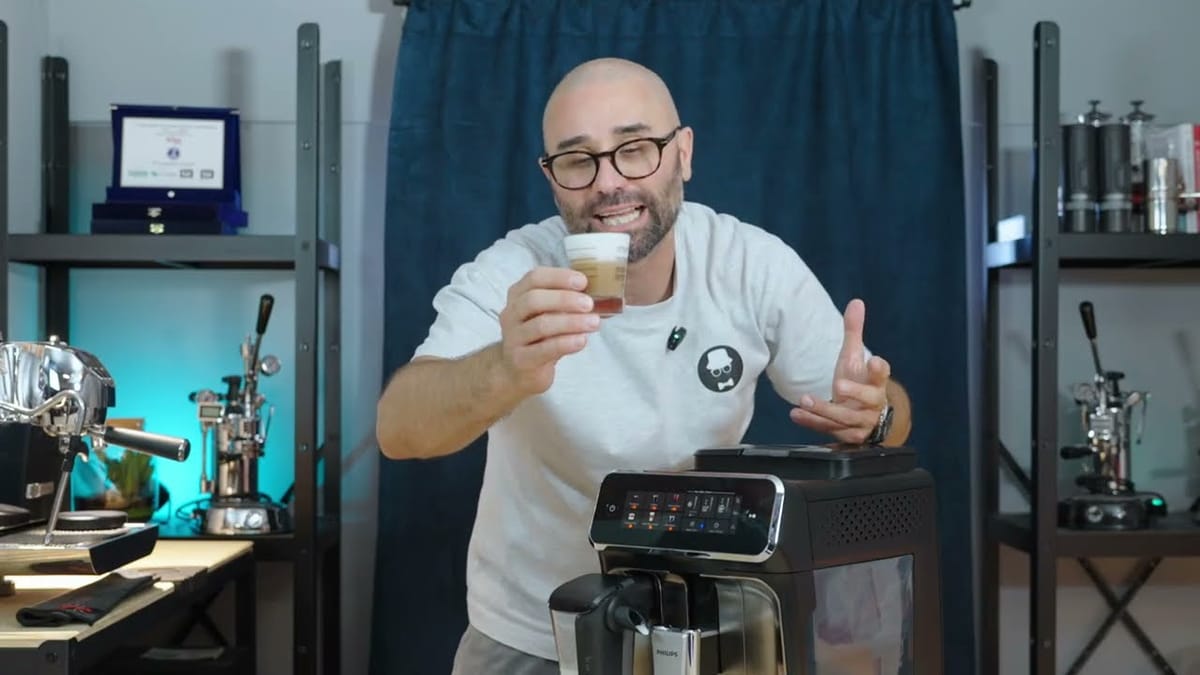
This Philips 3300 review starts with a practical fix for weak coffee: Angelo selects a high dose and a short espresso, then works on the grind. His video also examines automatic milk and the limits of judging coffee by crema. It is in Italian: on YouTube, enable CC and choose Settings, Subtitles, Auto-translate, English.
Why does the Philips 3300 make watery coffee?
Start by checking the drink volume against the dose setting. In this test, Angelo looks for a fuller espresso by selecting the maximum dose and minimum espresso volume. That is his starting point for the coffee he is using, not a universal recipe for every bag.
Two controls can look like different ways to ask for a stronger coffee, but they do different jobs. Asking the machine to grind more coffee is not the same as asking it to put more liquid in your cup. Increasing the drink volume to fill a larger cup does not automatically make the result more intense.
Begin with a short drink and taste it without milk or sugar. Look for a satisfying texture, but also a flavour you enjoy. More body does not necessarily mean better balance. Our guide to watery espresso and its causes helps separate strength from other extraction problems.
How should you adjust the grinder and temperature?
Change one variable at a time instead of treating the video's settings as instructions for every coffee. With his test coffee, Angelo prefers a fine grind and says he lowered the brewing temperature from its initial setting.
There is an important handling rule: Philips says to adjust the grinder only while it is grinding, one notch at a time. Allow two or three coffees before assessing the change. Do not sweep the knob through several positions in pursuit of an immediate result.
Temperature is not simply about how hot the drink feels. In Angelo's explanation, it also relates to the flavour of the coffee, discussed in the context of darker blends. Before reproducing a button combination, check the instructions for your exact model code. The useful lesson here is to compare the taste, rather than copy a sequence blindly.
Write down your starting setting. Changing the beans, drink volume, dose and grind together might produce a nicer cup, but it will not tell you which change helped. A small, repeatable adjustment gives you something you can learn from.
Does more crema mean better espresso?
No: crema is part of the espresso experience, not a final score for flavour. Angelo connects its formation with roasting and bean freshness, shifting attention from the machine alone to the coffee inside it.
The SCA's explanation of coffee freshness describes carbon dioxide formed during roasting, partly retained inside the bean and gradually released. During brewing, that gas contributes to crema. It does not follow that coffee straight out of the roaster will always make the best-tasting cup.
Look at the surface, then taste the drink. Do you enjoy the finish? Does the body suit what you wanted? A dramatic layer of foam cannot answer those questions. The SCA's discussion of crema research also distinguishes visual expectations from the sensory experience of drinking espresso.
Angelo points out another everyday issue: the hopper does not detach for easy emptying. If you are thinking about how much coffee to keep ready and how to store the rest, see our guide to storing coffee beans, including the distinction between storage and resting after roasting.
What is the Philips 3300 LatteGo milk like?
In the demonstration, it produces generous foam that Angelo finds too airy and slightly too hot for his personal taste. He dispenses it into a pitcher so you can see the texture separately from the finished drink.
That is a useful distinction when assessing an automatic milk system. One-touch preparation solves a convenience problem, but plenty of volume does not establish whether you will enjoy the texture. If you prefer more compact foam, assess the actual result rather than the cappuccino photograph.
Angelo also corrects his initial explanation of the milk control during the video. Watch through to the demonstration rather than relying on the first tour of the buttons. For the operation of your particular variant, use the instructions supplied for that machine.
Is the Philips 3300 better than capsules?
Angelo prefers bean-to-cup machines because they grind the beans when preparing the drink. This video does not, however, present a blind tasting against named capsules. His conclusion concerns the system and daily use, rather than proving that every bean-to-cup coffee beats every capsule.
He also discusses running costs. The prices he mentions belong to the review, not a current price list. A useful comparison needs your own consumption, the coffee you would actually buy, the machine's purchase price and maintenance. A price per kilogram alone does not tell you what your usual drink will cost.
The practical decision is whether you want to choose your beans and take responsibility for adjustment and cleaning. If you mainly want a repeatable single action, ask how much you would use that extra freedom. Before blaming the machine, try changing only espresso volume and compare the cups: it is a simple way to test what you are asking it to produce.
Join the Caffinity community
Caffinity Premium offers extra content and behind-the-scenes material from Angelo's videos, enhanced partner-roaster discounts and private Discord channels. Explore Caffinity Premium on Patreon. Do not assume that all material is available in English.
For more practical machine tests, subscribe to Angelo's YouTube channel. The videos are in Italian; use YouTube's subtitle and automatic translation options when available.
Bring your settings and questions to the free Caffinity Discord community and compare notes with other coffee drinkers.
Read next
Coffee grinder for espresso, moka and filter: what to look for
Manual or electric, ceramic or steel, stepped or stepless: Angelo’s video compares grinders and shows what to consider for your brewing method and daily routine.
Coffee deals on Telegram: we're sharing them on Amanti del Caffè
After our community poll, we’ll share Amazon offers on coffee machines, grinders and accessories on Amanti del Caffè on Telegram, ahead of Black Friday.
Lelit Anita review: how it compares with the Gaggia Classic Pro and Pavoni
An integrated grinder, a separate setup or a manual lever: Angelo compares the Anita, Classic Pro and Europiccola, and explains what his test can and can’t tell you.