
How to clean a moka pot and know when to replace it
Coffee residue, limescale and a damaged surface need different answers. Revisit Angelo's aluminium moka demonstration without treating dark marks as a safety test.

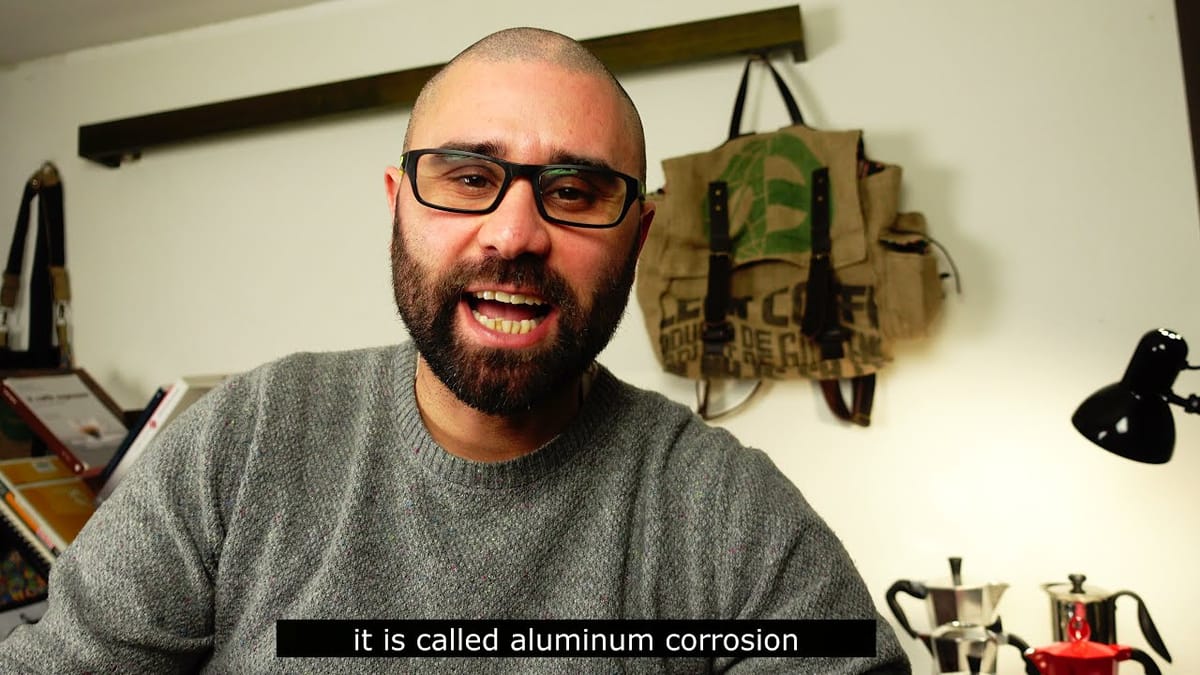
Learning how to clean a moka pot starts with separating coffee residue, limescale and possible damage: they do not all need the same treatment. Angelo explores these differences in the video below. It is in Italian; on YouTube, use CC, Settings, Subtitles and Auto-translate to select English. For the actual cleaning procedure, follow your model's manual.
How to clean a moka pot after use?
Start by identifying what needs cleaning, rather than reaching for the strongest product. Angelo begins with the upper collecting chamber, showing the film left by coffee oils. His point is not that oils are bad: they contribute to the drink. Leaving them on the brewer afterwards is a different matter.
He also challenges the familiar claim that a dirty pot makes better coffee. In the comments, he explains that people can become accustomed to a more bitter, oxidised taste. Familiarity does not establish that the residue improves the next brew. A flavour you recognise and a clean brewer are separate questions.
For the Moka Express, the Bialetti manual specifies complete cooling, warm water without detergents or abrasives, thorough drying and storage without closing the pot. That advice belongs to that product, not automatically to every stovetop brewer.
Can you clean a moka pot in the dishwasher?
Not the Moka Express, according to its manufacturer. Angelo likewise warns against treating an aluminium pot as a plate that needs vigorous scrubbing. His explanation of how soap works addresses the difficulty of removing oils; it is not permission to use dishwashing liquid on every moka.
He demonstrates a particular cleaning product, but the transcript does not reliably identify it or provide its instructions. We are therefore not turning that demonstration into a shopping recommendation. Descriptions such as natural or renewable are not enough, on their own, to choose a cleaner for your equipment.
The practical question is which treatment the manufacturer specifies for the brewer in front of you. If its booklet has disappeared, finding the correct instructions is a better first step than trying a succession of household products.
How do you clean moka pot limescale?
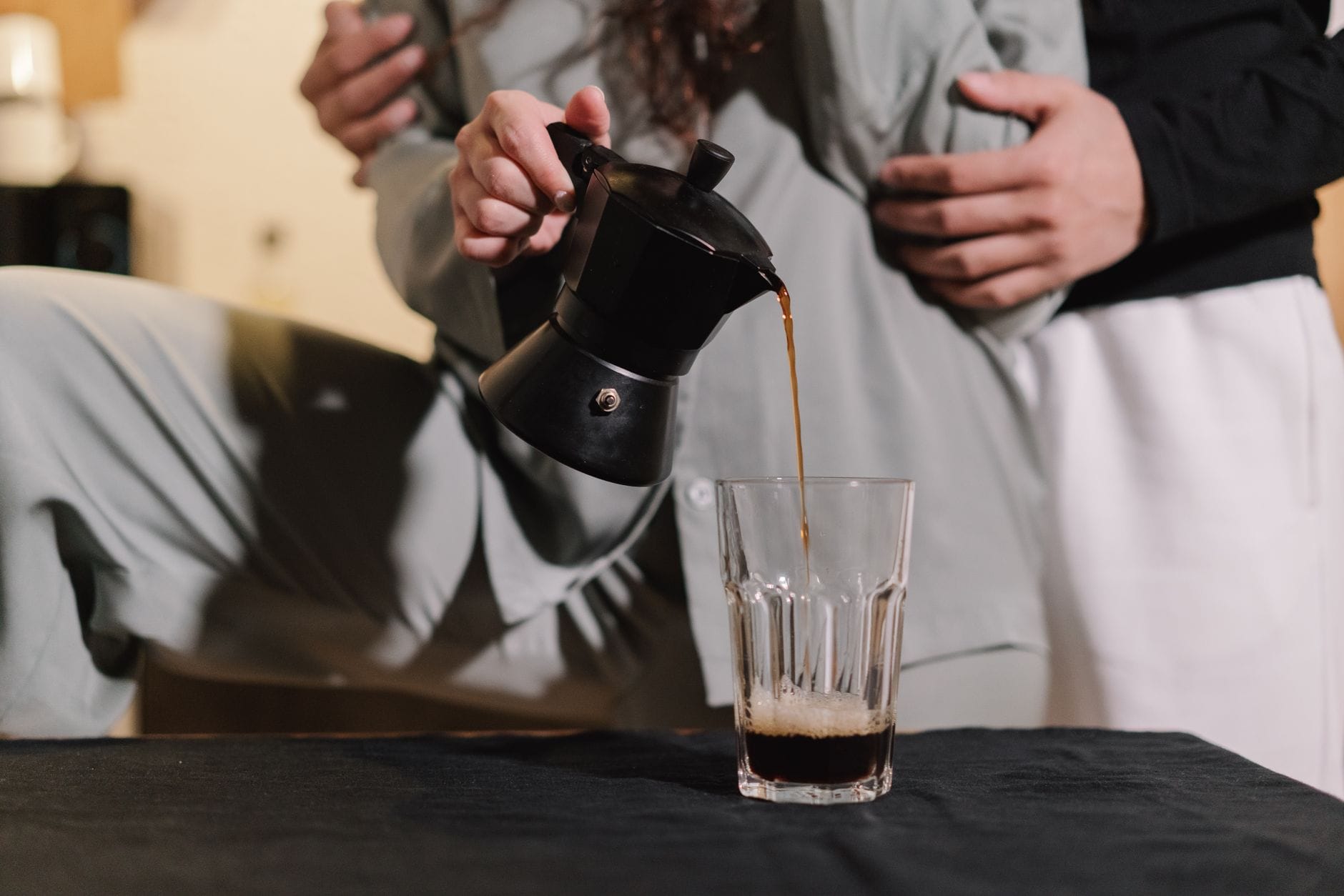
Treat limescale separately from coffee residue in the collecting chamber. Angelo makes that distinction physically, moving from the upper chamber to the boiler. A coffee-stained surface and deposits in the water chamber are not the same target.
His 2021 video proposes a water-and-vinegar soak. We are not presenting it as a universal procedure: the Moka Express manual consulted describes a different treatment. Follow your own model's directions rather than combining concentrations and timings from unrelated recipes.
Our guide to daily moka care and limescale explores this distinction further. For the water itself, read what water changes in coffee, without assuming that any bottled water will solve every maintenance problem.
When should you replace an aluminium moka pot?
A mark alone cannot establish either danger or safety. In the video, Angelo points to dark spots and streaks as signs that concern him. In replies to viewers describing their own pots, however, he also states that he is not a chemist and cannot always give a definite answer.
That limitation matters just as much as the demonstration. Watching a video does not measure how much metal enters a particular cup. Nor can we promise that cleaning will make a damaged brewer fit for use again. A visual comparison is not a laboratory test.
The manufacturer says not to use a malfunctioning brewer and to contact the retailer or manufacturer when in doubt. Before deciding that the entire pot needs replacing, establish whether the issue concerns a compatible replacement part or the body itself. Sentimental value can be a reason to keep an old pot, not to keep brewing with an unresolved problem.
Is a stainless-steel moka pot better than aluminium?
Steel does not remove the need for maintenance. Angelo presents it as a practical alternative near the end of the video, but his comments offer a less absolute picture: he uses steel at home and aluminium at his mother's house. Those habits do not need to become a universal ranking.
Check washing instructions for the individual steel model too; do not extend everything said in the video to every stainless-steel brewer. Today's useful step is simpler than buying a replacement: look separately at the collecting chamber, boiler and components, then compare what you find with the correct instructions.
On Patreon this week
For Premium members, Angelo wrote a follow-up on this topic, in Italian and English: Aluminium moka pots: your stains, my replies and unanswered questions. The opening is free to read.
Join the Caffinity community
Caffinity Premium includes extra content, behind-the-scenes material, enhanced partner-roaster discounts and private Discord channels. This is not a promise of English-language videos or lessons.
For equipment demonstrations and coffee tastings, subscribe to Angelo's YouTube channel. Join the free Caffinity Discord chat to compare your routine with other coffee enthusiasts.
Read next

Coffee grinder for espresso, moka and filter: what to look for
Manual or electric, ceramic or steel, stepped or stepless: Angelo’s video compares grinders and shows what to consider for your brewing method and daily routine.

Giannina moka pot review: Angelo brews three cups and one
Angelo tries the Giannina’s lever-operated closure and reversible filter, then tastes both serving sizes. A first look, not a head-to-head moka comparison.
Cappuccino without espresso machine: three ways to froth milk
A French press, handheld frother and bottle each make a different milk texture. Watch Angelo and Barbara try them, and see why you shouldn’t put milk in a moka pot.